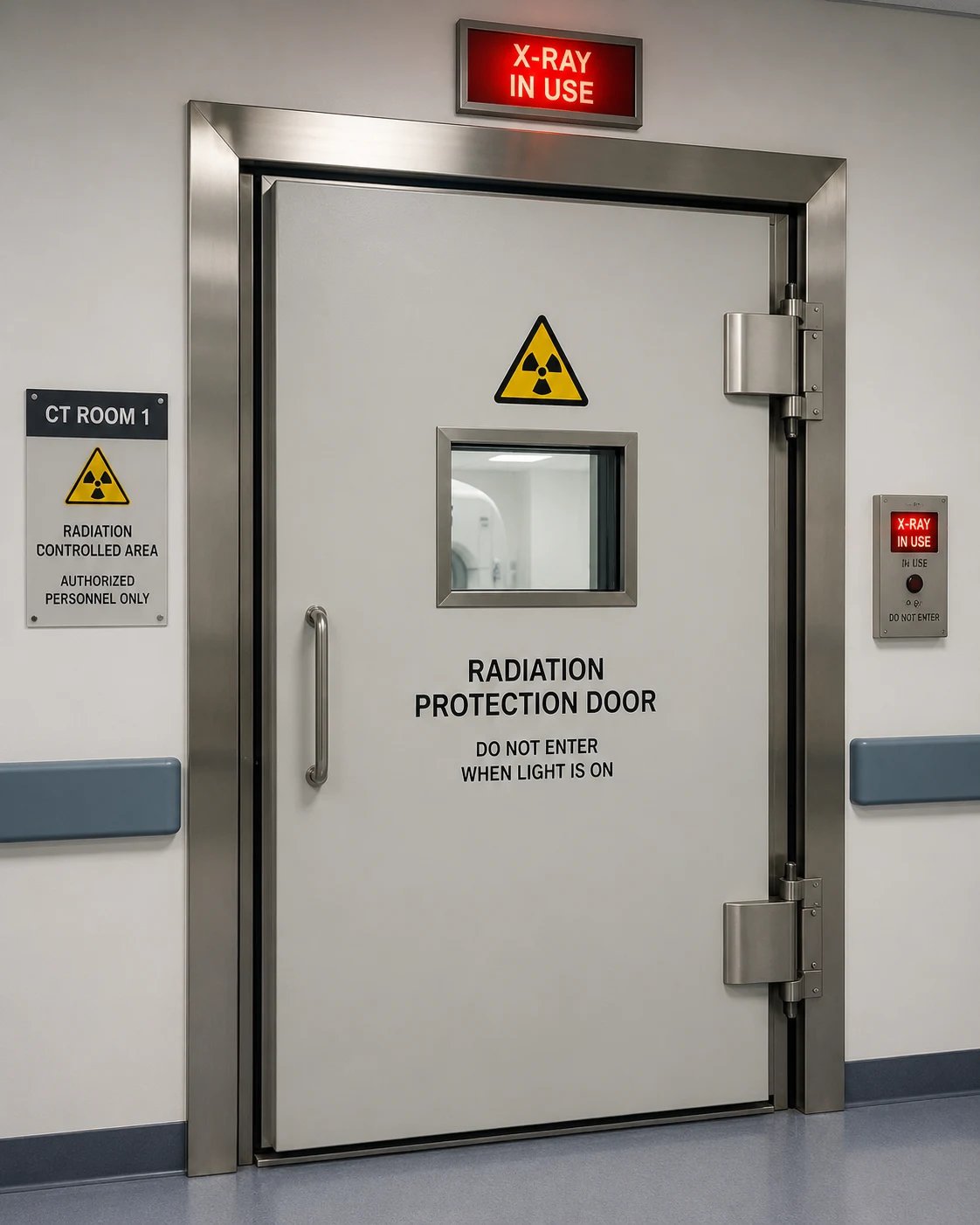
Lead Lined and Radiation Protection Doors
A lead lined door is the one element of a shielded room that moves, and therefore the one most likely to leak. The shielding has to be continuous across the leaf, round the frame and past the hinge line — a lead sheet that stops at the edge of the leaf leaves a gap exactly where the radiographer stands.
Lead equivalence
The required thickness is not ours to assume. It is set by your Radiological Safety Officer or shielding consultant from the workload, the tube potential, the occupancy on the far side of the wall and the distance. Typical values run from 1.5 mm Pb for a general radiography room to 3 mm Pb or more for CT and cath labs. Send us the shielding report and we manufacture to it.
How our lead doors are built
- Continuous lead sheet bonded to the full leaf area, with lapped joints — never butt-jointed.
- Lead lined frame with the shielding carried past the rebate so there is no line of sight through the gap.
- Lead glass viewing window at matching equivalence where observation is required.
- Heavy-duty hinges rated for the leaf weight, which is considerable once the lead is in.
- Sliding versions for rooms where a swing leaf would obstruct patient trolley access.
Applications
X-ray and radiography rooms, CT and MRI suites, cath labs, dental imaging, nuclear medicine, linear accelerator bunkers, and industrial radiography enclosures.
Handover
Each door is supplied with a declaration of the lead equivalence achieved, which forms part of the room's AERB compliance file.